

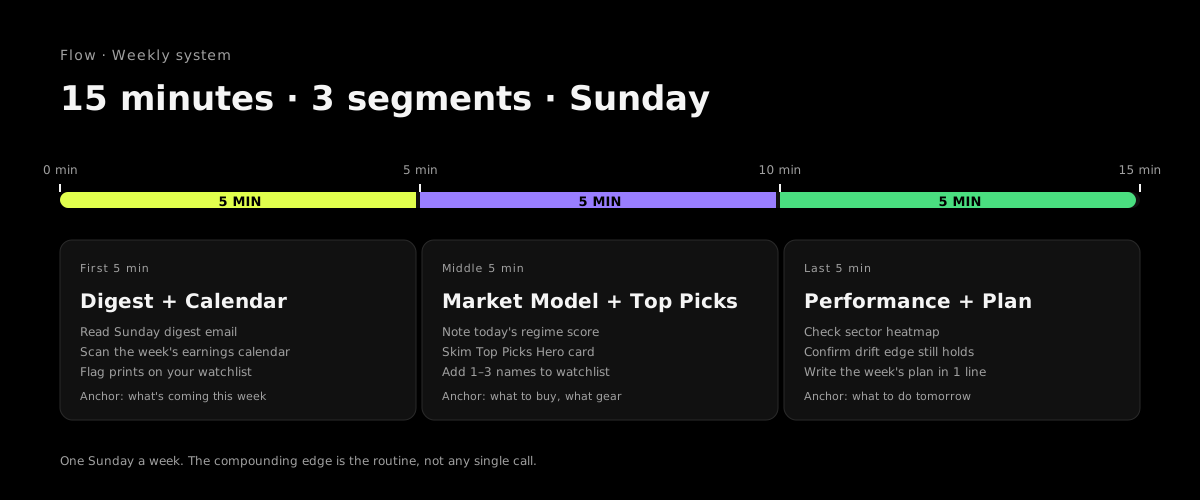
The single biggest determinant of whether you make money on this platform is whether you show up consistently. Here's a 15-minute Sunday-night routine that compounds.
Why Sunday night
By Sunday at 8 PM ET, earnings dates for the week ahead are confirmed, our weekly digest email has landed in your inbox, and you have one quiet hour before Monday's chaos. Do this 50 weeks a year and you've spent 12 hours total — less than a single day of "stock research" — and you'll know your portfolio's earnings exposure cold.
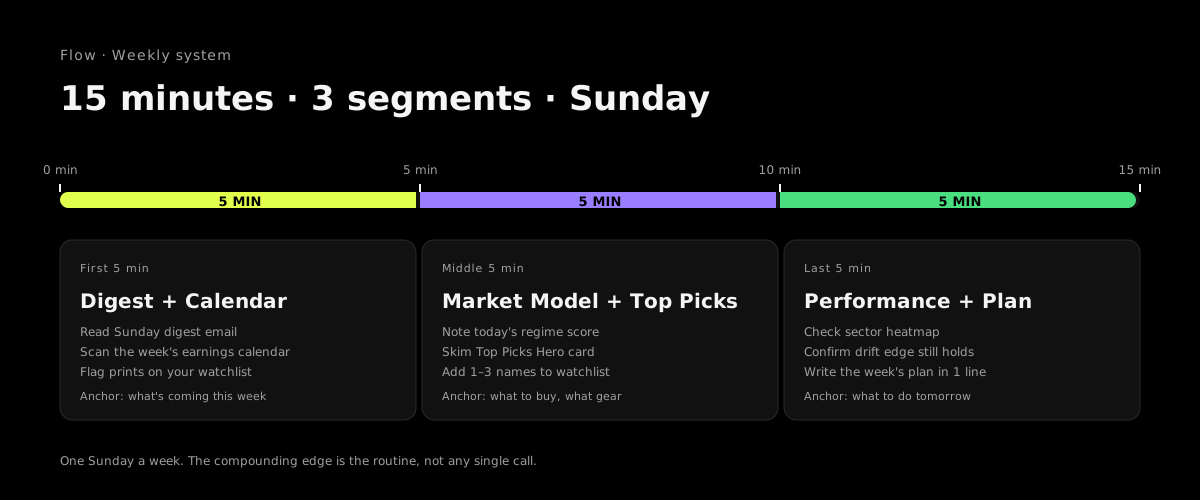
The 15-minute checklist
Step 1 (Minute 0-3): Read the weekly digest
Open the digest email we send Sunday at 8 PM. It has the week's most anticipated earnings with logos and timing. Skim it. Note any name you don't recognize that's reporting on a major day (Tue/Wed/Thu typically pack the calendar). If you don't get the digest, opt in from your account page.
→ Account settings (digest opt-in)
Step 2 (Minute 3-5): Watchlist scan
Open Watchlist and sort by Next Earnings Date. You're answering one question: which of my names report this week? Three possible answers:
- None — skip steps 3-4. Spend the time on step 6.
- 1-3 — light week. Read each one's ticker page carefully.
- 4+ — heavy week. You need a hold/trim/hedge plan for each.
Step 3 (Minute 5-7): Market Model check
Open Market Model. Note the score and trend over the last 7 days. Three reads:
- Above 60 and stable or climbing — green light for earnings trades. Be aggressive on Top Picks setups.
- 40-59 or chopping — be selective. Skip marginal setups. Only the highest-conviction names.
- Below 40 or dropping fast — defense mode. No new earnings positions. Tighten stops on existing names.
The Market Model guide covers the regime bands in detail.
Step 4 (Minute 7-10): Top Picks scan
Open Top Picks. Look at the current 10. Three things to note:
- What sectors are dominating? That's where the model thinks the flow is going.
- Any name you haven't seen before? Note it — might be a new compounder breaking out.
- Any name on the list also reporting this week? Highest-priority setup of your week.
You're not buying anything yet — you're orienting. The full discovery loop lives in the Find a Winner flow.
Step 5 (Minute 10-13): Performance read
Open Performance. Filter to the most recent complete quarter. Three reads:
- Which sectors have the best 1-month post-ER drift? Bias new ideas there.
- Are beats getting bought or sold by month 4? Day-trade flips vs swing holds.
- Any sector with a beat-rate change vs the prior quarter? Sectors rotate; you want to see it early.
The Performance guide walks each filter.
Step 6 (Minute 13-15): Write your plan
For each watchlist ticker reporting this week, write one line:
TICKER (Wed AMC) — HOLD / TRIM / HEDGE / EXIT — reasonExample:
AVGO (Thu AMC) — HOLD — pattern healthy, sector strong, model bullish
MDB (Tue AMC) — TRIM 50% — last print was -24%, pattern broken
PLTR (Mon AMC) — HOLD — six straight beats, watchlist core
That's the whole routine. 15 minutes. Done. (For the protective side of this — knowing when to TRIM/HEDGE/EXIT — read the Avoid Disasters flow.)
→ Open Watchlist to execute the plan
What changes during the week
Mostly nothing. You executed your plan on Sunday. The only intra-week task: the morning of any print, open the ticker page (e.g. /earnings/NVDA) and read the AI Earnings Analysis paragraph (for the deeper bull/bear take, open the AI Report from your watchlist). The morning after any print, check the actual reaction. If it surprised you, spend 2 minutes understanding why. That's where the real learning compounds.
Anti-patterns
What doesn't work:
- Reading every earnings story in the news — wastes hours, adds no edge.
- Watching CNBC during prints — pure noise, opinionated takes with no skin in the game.
- Trading off Twitter pump posts — survivorship bias, you only see the wins.
- Adding 50 stocks to your watchlist — you can't pay attention to 50 names.
- Trying to call every print — you need to be right on the ones you care about.
After 12 weeks of this
You'll have a trimmed watchlist of 15-25 names you genuinely understand. A felt sense of which sectors reward beats and which fade them. A notebook of plans-vs-outcomes that shows your own patterns. A baseline read on the Market Model that makes "Bullish" or "Defensive" mean something. Skipped 10-15 prints that would have hurt you, and held 5-8 that delivered. That's the compounding edge — not a single trade, but a habit that puts you in front of the next 50 prints with a plan.
Next
Read Real Examples From Our Database for the actual numbers behind every claim in this guide.